The real bottleneck is usually not sales. It is people. More specifically, it is how well you understand and manage the people you already have.
This is the part most leaders learn the slow way, after a wrong hire, a quiet resignation, or a team that just stops getting along. Here is how to see it earlier, and manage it on purpose instead of by accident.
The problem a résumé will never solve
A résumé tells you what someone has done. It does not tell you how they work.
It will not tell you that your new hire moves fast but skips detail. Or that your best analyst overthinks every decision and freezes under pressure. Or that two of your strongest people quietly grind against each other every time they share a project.
None of that shows up in an interview either, at least not reliably. People perform in interviews. The real working style only appears weeks later, once the pressure is on and the polish wears off.
By then, you have already made the placement. And a wrong placement is expensive. You pay for it in training time, lost clients, team morale, and the cost of hiring all over again.
Every person works in a different way
Walk into any growing company and you will see the same mix of working styles:
Some people are slow and steady. They are reliable, careful, and calm, but they need time and they resist being rushed.
Some are result driven. They move fast, push hard, and close things, but they can run over people and skip the details that hold a process together.
Some overthink and never quite execute. They see every angle, raise every risk, and produce brilliant analysis, but they stall when it is time to commit.
None of these is wrong. Each one is a strength in the right seat and a liability in the wrong one. The result-driven person is a gift in sales and a problem in compliance. The careful overthinker is a gift in risk and a problem in a fast sales floor.
The job of a leader is not to change these people. It is to place them where their natural style becomes a strength, and to manage them in a way that works with their nature, not against it.
Why this gets harder the bigger you grow
When your team is small, you feel all of this without trying. You sit next to people. You notice the tension. You know who needs a nudge and who needs space.
Then you grow. Thirty people. Fifty. A hundred across a few locations. And suddenly you cannot feel the team anymore. You only hear about a problem after it has already cost you something.
This is the moment most companies lose their grip on team health. Not because the leader got worse, but because the team got too big to monitor by instinct alone. You need a way to see the whole team at once, instead of discovering the friction one resignation at a time.
What good people management actually looks like
Strong people management comes down to three habits.
Place people by their nature. Put each person where their working style is an advantage. Stop trying to fix a personality and start matching it to the right role.
Manage with a clear next move. For every person, know the one thing that gets the best from them. The fast one needs a clear lane and a checkpoint. The careful one needs time and trust. The overthinker needs a deadline and permission to commit.
Build the team as a system, not a pile of individuals. Two strong people can still make a weak team if their styles clash. A great team is balanced on purpose: drivers and finishers, thinkers and doers, placed so they cover each other's gaps.
Notice what is not on this list: firing people. Good management is not about removing the people who frustrate you. Most of them are simply in the wrong seat, or being managed against their nature. Move them, or manage them differently, and the so-called problem often becomes a strength.
A healthy team is not luck. It is design.
The companies with calm, productive teams did not get lucky. They placed people well, managed them by their nature, and built balance into the team on purpose.
That used to take years of instinct to do well. Now it is something you can see and plan for, even at scale.
See your team clearly with TalentLens
This is the exact problem I built TalentLens to solve.
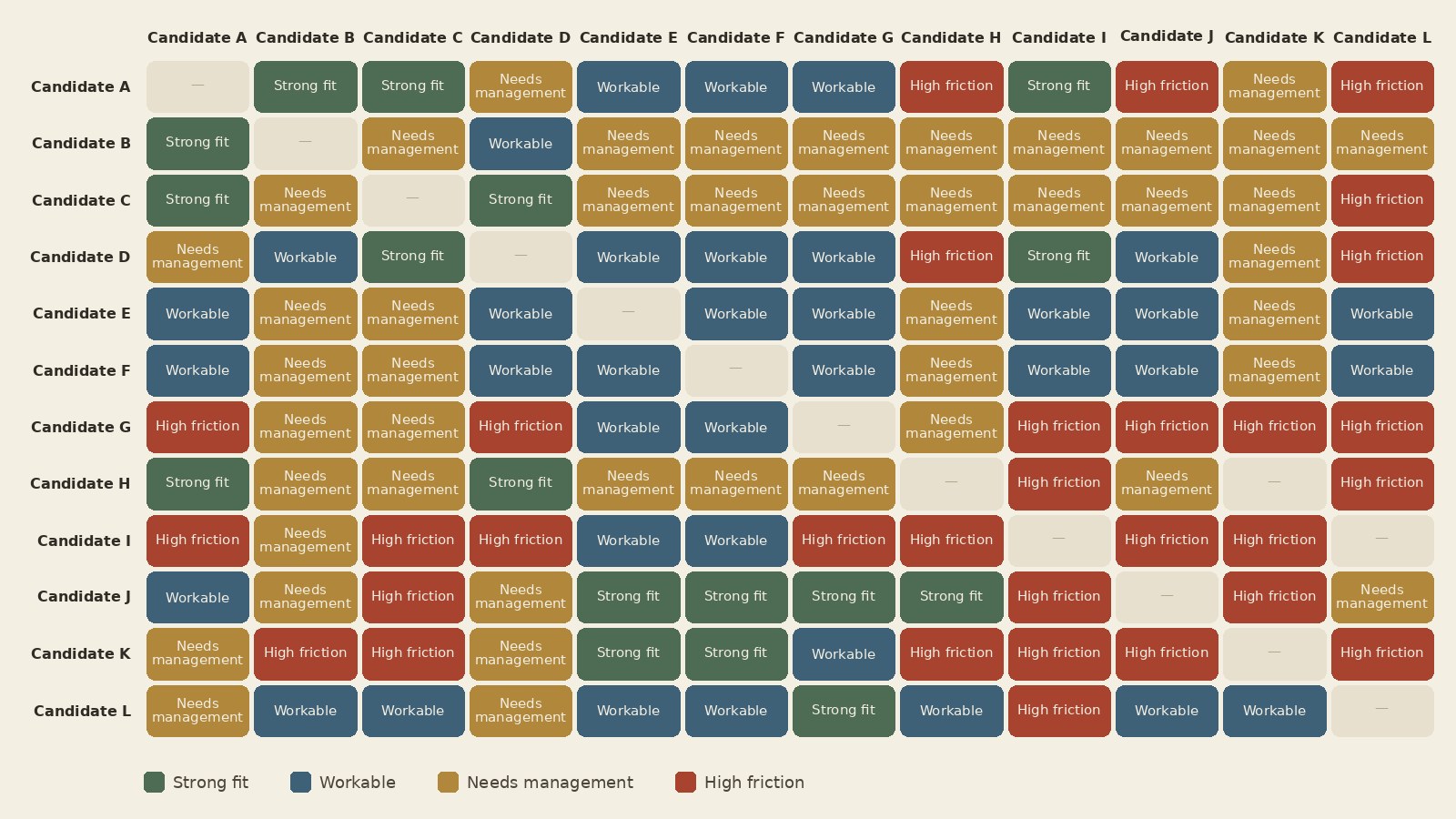
TalentLens gives you a clean, plain-language read on how each person works: their strengths, their blind spots, how to manage them, and how well they fit a given role. You can check how any two people are likely to work together. And you can see your whole team in one colour-coded view, so you know at a glance who is thriving and who needs managing. Green means strong. Red means manage, not panic. For every point of friction, you get the practical move to lead through it.
It reads like a premium talent assessment, in business language, with no jargon. It is a supplementary aid, used alongside your interviews and normal judgement, never a replacement for them. And it is built for placement, management, and development, not for removing people.
TalentLens is a paid tool, but right now it is open to try for free. If you want to see your own team through it, you can request a free account here.
Because a healthy team is not luck. It is design.
See your own team clearly
TalentLens gives you a plain-language read on how each person works, how any two fit together, and your whole team in one colour-coded view. Open to try for free right now.
Request a free account →